

What Were You Solving? Symptoms as Messengers | Sacred Alchemy
What Were You Solving? Symptoms as Messengers | Sacred Alchemy. A Sacred Alchemy perspective on symptoms, Jungian depth psychology, and the shamanic view of illness as message
This is the question I ask when someone is stuck by a diagnostic label, a treatment-resistant symptom, or a pattern of suffering that hasn't responded to everything tried.
I believe symptoms are teachers beneath their surface, offering solutions. They're extraordinarily faithful, persistent and intelligent, solving problems that couldn't be addressed otherwise.

The Language of the Soul
In almost every session, a quiet moment arrives without warning. Someone might be discussing their week, job, marriage or an argument they can’t seem to shake. Amidst an ordinary sentence, a word takes on a new meaning.
A metaphor repeats itself for the third time in an hour unnoticed. A voice catches on a particular phrase. A seemingly unrelated dream surfaces.
This is the moment I lean in.
Because everything is speaking. Every thought, feeling and action is communicating and my work, at its core, is helping you understand what it’s trying to convey.
Why Does My Body Hold Tension? The Story Beneath the Symptom
Wondering why your body holds tension long after the moment has passed? Explore the mind body connection and what somatic symptoms are really trying to tell you.
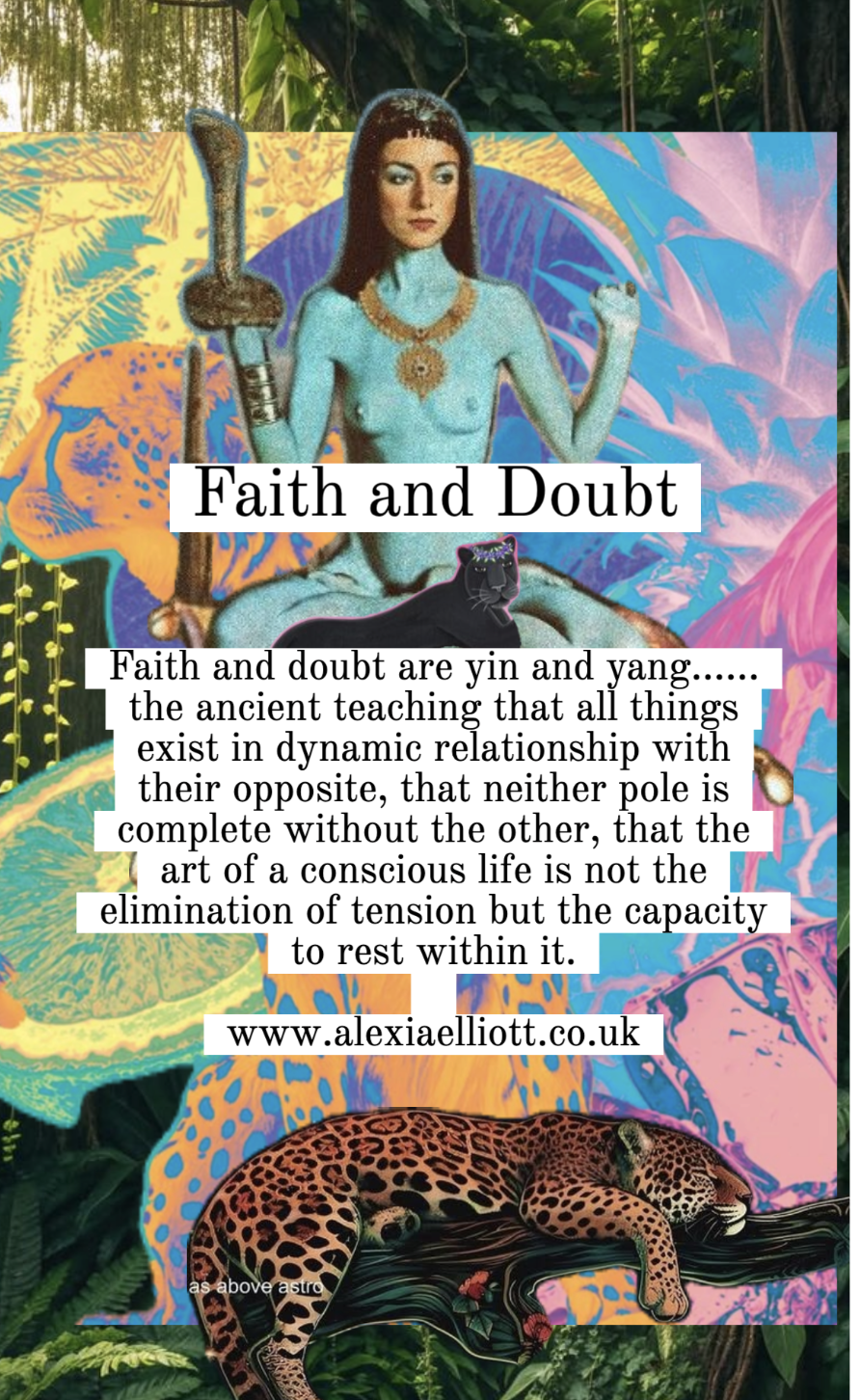
FAITH AND DOUBT
Faith and doubt are yin and yang…… the ancient teaching that all things exist in dynamic relationship with their opposite, that neither pole is complete without the other, that the art of a conscious life is not the elimination of tension but the capacity to rest within it.

5 Reasons to Train in Sacred Alchemy
Sacred Alchemy is the guiding principle behind everything I do. It’s a dynamic approach to inner work and transformation drawing on clinical hypnosis shamanic practice NLP and Jungian depth psychology. Unlike rigid systems or fixed curricula, it’s a holistic way of working with the whole person – psyche, body and spirit – transcending most therapeutic models. I offer Sacred Alchemy Practitioner Training at both Foundation and Advanced levels in Leicester and online. Here are five reasons people choose to train in it.
1. It works — and you'll feel it in yourself first
The Sacred Alchemy training is more than just professional development; it’s a personal journey. You learn by experiencing the work within yourself before offering it to others. This isn’t incidental; it’s the core of the training. The quality of your presence as a practitioner is deeply connected to the depth of your own inner work. Those who train in Sacred Alchemy don’t simply leave with new skills; they leave changed.


5 Ways to Connect With Your Power Animal
In shamanic traditions across the world, the power animal is understood as a guardian spirit a presence from the natural world that lends you its qualities, walks beside you, and offers protection and guidance in times of difficulty or transition. This is not mythology. It is a living practice, and one that people find surprisingly accessible once they know how to listen.
As a shamanic practitioner based in Leicestershire with nearly two decades of practice, I've guided many people into relationship with their power animals and witnessed how transformative that connection can be. Here are five ways to begin.
1. Shamanic journeying
The traditional way. Using rhythmic drumming, typically at around 4 to 7 beats per second you enter a light trance state and journey into what shamanic traditions call the lower world, a realm of nature and instinct where power animals tend to dwell. You move through an opening in the earth, a tree root, a cave, a body of water and allow what comes to you. You don't choose you receive whatever animal appears repeatedly or with particular presence is worth paying attention to.

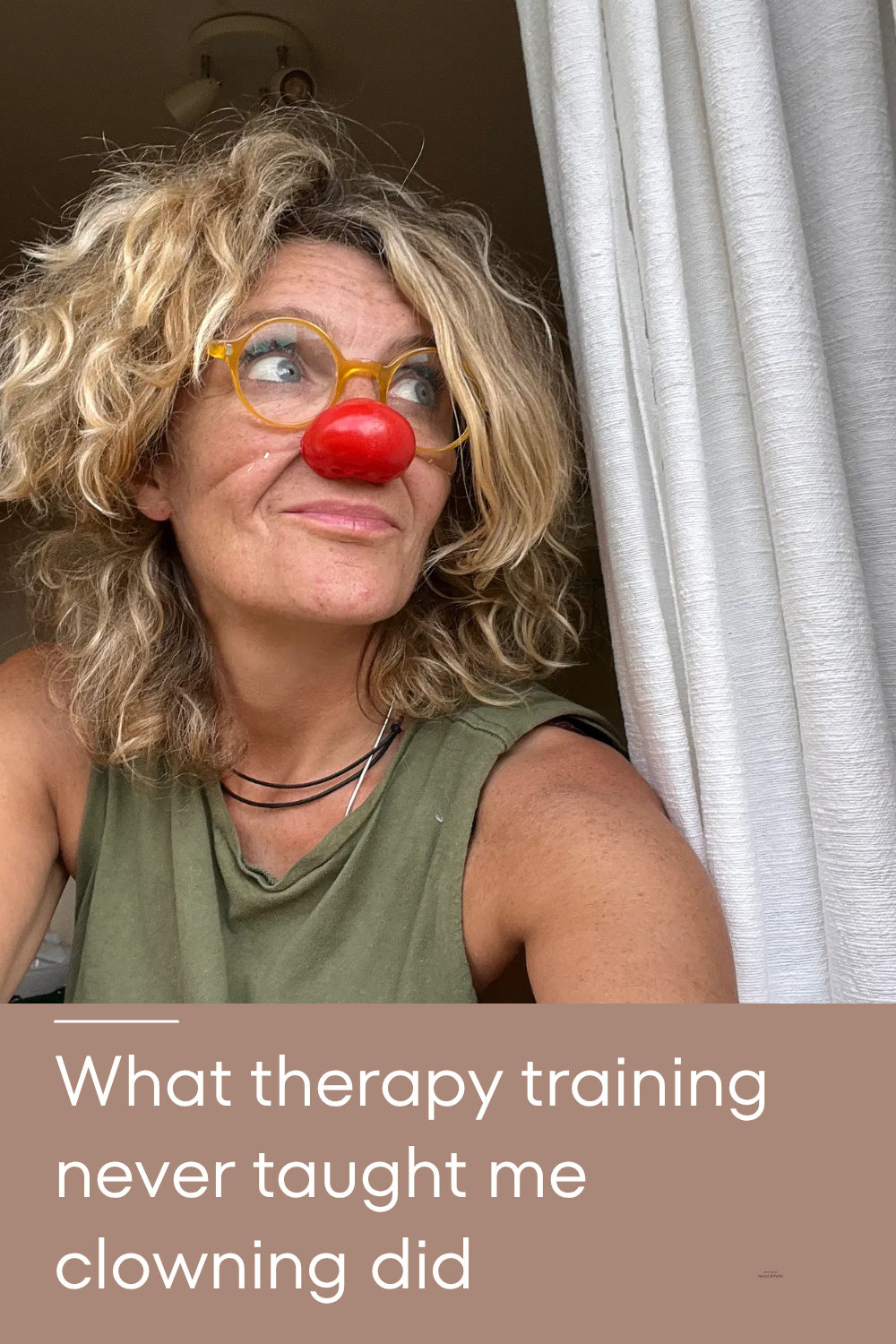
What Twenty Years of Therapy Training Never Taught Me That Clowning Did
I stumbled into clowning, It was 2015 and I had recently got into studying reading fairy tales. I looked up a term online and somehow ended up on the Emerson College website and nearly signed up for a storytelling course, and then I saw it. Clowning. I read about it quickly and I booked a place.
I had absolutely no idea what I was walking into but went anyway and I loved it.
It is not easy, clowning. Except that it is, completely, the moment you stop trying. That paradox is the whole thing, really.
The entire teaching is folded inside it. One of the first improvisations I did was the empty space exercise. You stand on a stage with one object a piece of cloth and you go with what happens, and something always happens. No plan, no script, no character.

The Shadow -What Jung Meant and Why It Matters for Your Healing
Carl Jung gave us many things but perhaps none more practically useful than the concept of the shadow.
The shadow is, in simple terms, everything we have disowned. The parts of ourselves that were deemed unacceptable by our parents, our culture, our religion, our peer group, or our own developing sense of who we needed to be to survive and belong and were therefore pushed below the threshold of conscious awareness.
This is not the same as everything dark or negative. The shadow contains our rage, yes, but also our vitality, our sexuality, but also our creativity our selfishness, also our ambition and our power. Whatever was not welcome in the environment where we grew up whatever we learned to hide, suppress, or pretend did not exist went into the shadow.
Hypnotherapy for IBS and Digestive Issues
The Gut That Listens to Everything
Your digestive system has its own nervous system. Around 500 million neurons line the gut, forming what researchers sometimes call the second brain. This enteric nervous system is in constant two-way communication with the brain -- which means that what is happening emotionally and psychologically is always being registered in the gut. And what is happening in the gut is always influencing mood, thought, and nervous system state.
This is not metaphor. It is physiology.
Hypnotherapy for Imsomnia
Why You Cannot Just Switch Off
If you struggle with sleep, you will probably have been told to try a consistent bedtime, to avoid screens, to cut caffeine, to keep a cool room. These things are not wrong. But if you are lying awake at two in the morning with a mind that will not stop, or waking at four and spiralling, or falling asleep easily and then jarring awake with your heart racing, practical sleep hygiene is unlikely to be the core of what is needed.

Hypnotherapy for Phobias
A Phobia Is a Very Efficient Piece of Learning
Here is something people find genuinely surprising: phobias are not irrational. They are extraordinarily efficient. Your nervous system learned, usually in a single overwhelming experience or through repeated association, that a particular thing is dangerous. And now it responds to that thing with the full force of the threat response, every time, without deliberation.
The learning is too thorough. That is the problem. Not the response itself -- the response is the nervous system doing exactly what it was designed to do -- but the fact that it fires in relation to something that does not actually pose the threat it once seemed to.
Hypnotherapy for Anxiety
Anxiety is not a malfunction. It is a pattern your nervous system learned, usually for very good reason. This post explains what is actually happening -- and offers three things you can try right now. Read more at alexiaelliott.co.uk
What Trauma Actually Is And Why Talking About It Is Only the Beginning
Trauma is not what happened to you. Trauma is what happened inside you when it happened. That distinction matters enormously, because it changes everything about how we approach healing.
Two people can go through the same event and have entirely different responses. One is shattered. The other walks away relatively intact. This is not about strength or weakness. It is about what was already in the nervous system the previous experiences, the early attachment patterns, the resources that were or were not available when the overwhelming event occurred.
Trauma is what happens when an experience exceeds the nervous system's capacity to process it in the moment. The event cannot be metabolised and integrated in the ordinary way. Instead it gets stored — in the body, in the nervous system, in the implicit memory system that operates below conscious awareness as an unfinished experience that the system keeps trying, and failing, to complete. Why Talking Is Not Always Enough